

THE SCIENCE OF VISION TRAINING
YOUR EYES SEE IT. YOUR BRAIN PROCESSES IT. YOUR BODY RESPONDS.
Vision is much more than seeing 20/20.
Athletic vision requires the eyes to locate and track information, the brain to interpret what that information means, and the body to produce the appropriate response. In baseball and softball, that entire process can happen in fractions of a second.
SEE → PROCESS → DECIDE → RESPOND
Sports-vision research describes athletic visual performance as a combination of visual, perceptual, cognitive and visual motor abilities—including tracking, visual attention, depth perception, eye-hand coordination, reaction and decision-making

20/20 TELLS US HOW CLEARLY YOU SEE.
IT DOESN'T TELL US HOW EFFICIENTLY YOU PROCESS AND RESPOND TO WHAT YOU SEE.


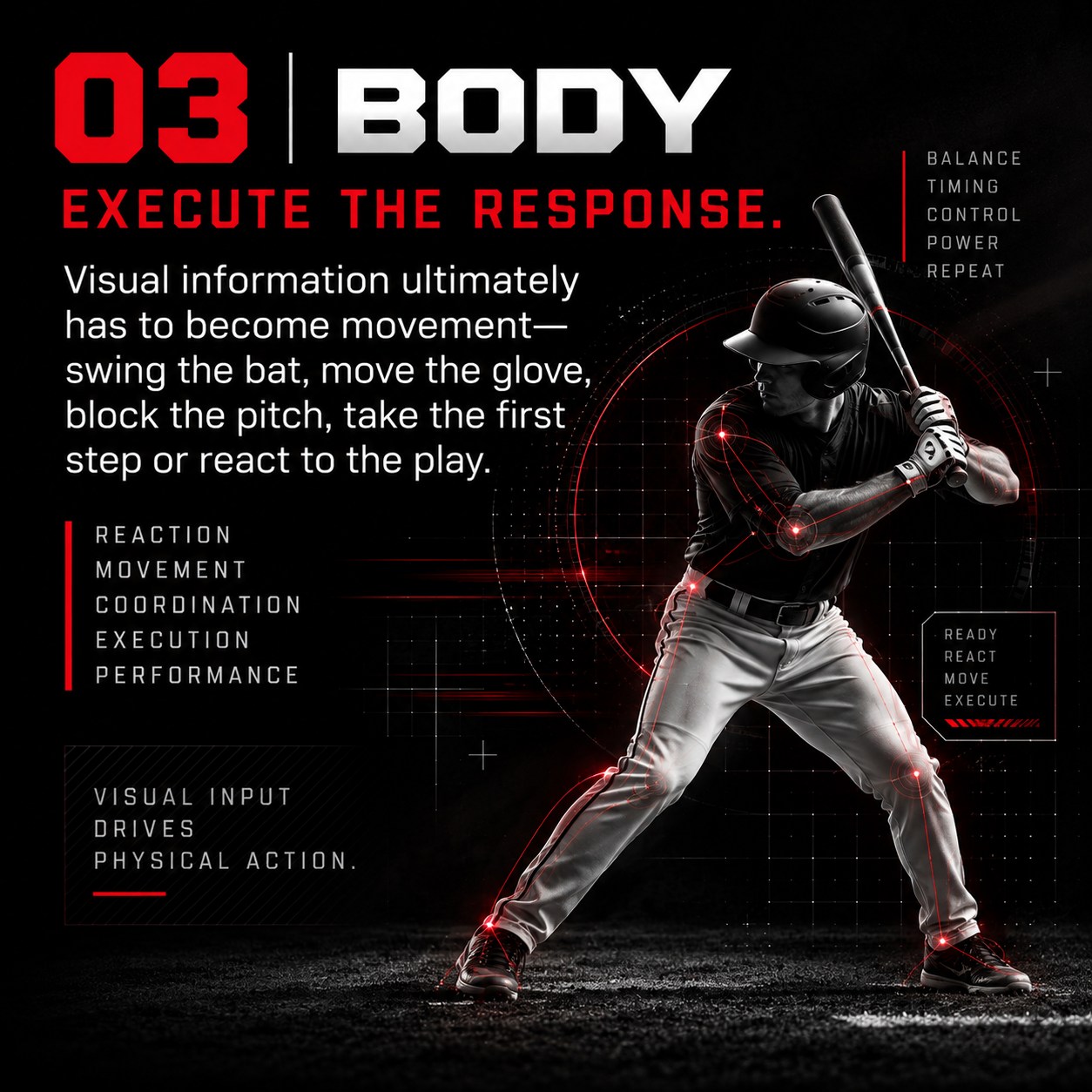
PERFORMANCE HAPPENS WHEN ALL THREE WORK TOGETHER.
WHAT ARE VISUAL SKILLS?
Visual skills are the abilities that allow your eyes and brain to work together to gather, interpret, and respond to visual information.
01 — PHORIA | EYE ALIGNMENT
The Question
Are my eyes properly aligned and working together?Definition
Phoria describes the natural alignment tendency of the eyes when binocular viewing is disrupted. Efficient alignment helps both eyes work together comfortably and consistently to maintain a stable visual picture.
02 — DEPTH PERCEPTION
The Question
Can I accurately judge where an object is in space?Definition
Depth perception is the ability to judge distance, depth, and the spatial relationship between objects. It helps an athlete determine how far away something is and interpret objects moving toward, away from, or around them.
03 — DIVERGENCE
The Question
Can my eyes efficiently adjust as my focus moves farther away?Definition
Divergence is the ability of both eyes to turn outward together while maintaining a clear, single image as visual attention shifts toward a more distant target.
04 — CONVERGENCE
The Question
Can my eyes work together as an object moves closer?Definition
Convergence is the ability of both eyes to turn inward together and maintain coordinated focus as a target moves closer.
05 — TRACKING
The Question
Can my eyes accurately follow a moving object?Definition
Visual tracking is the ability to control eye movements to follow a moving target or efficiently shift the eyes from one location to another while gathering visual information.
06 — VISUAL PROCESSING
The Question
How quickly and accurately can I make sense of what I see?Definition
Visual processing is the brain's ability to interpret, organize, and respond to information received through the eyes. In fast-moving environments, the athlete must not only see information but understand what it means quickly enough to make a decision.
07 — EYE-HAND COORDINATION
The Question
Can my body accurately respond to what my eyes see?Definition
Eye-hand coordination is the ability to use visual information to guide accurate physical movement. It connects what the athlete sees with the timing and control of the hands and body.
08 — PERIPHERAL AWARENESS
The Question
How much can I recognize without looking directly at it?Definition
Peripheral awareness is the ability to detect and interpret information outside the direct center of vision while maintaining focus on a primary target.
09 — ACCOMMODATION
The Question
Can my eyes quickly refocus between different distances?Definition
Accommodation is the eye's ability to change optical focus to keep objects clear as viewing distance changes. Efficient accommodation is important when repeatedly shifting attention between near and far targets.
10 — CONTRAST SENSITIVITY
The Question
Can I clearly distinguish an object from its background?Definition
Contrast sensitivity is the ability to detect differences between an object and its background, especially when the difference in brightness or contrast is small. It contributes to recognizing visual information in changing lighting, shadows, glare, or lower-contrast environments.